Strategy Performance Results
Real-world outcomes obtained by applying the Covered Call Strategy on Polymarket.
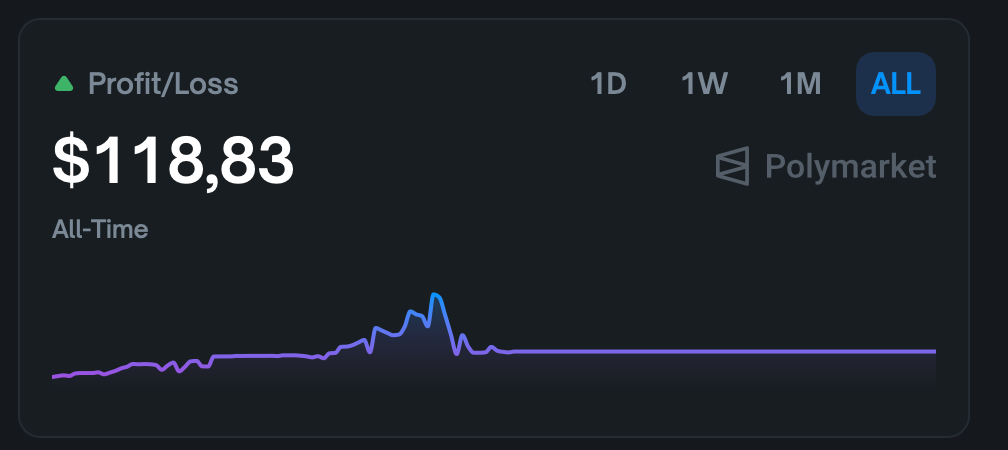
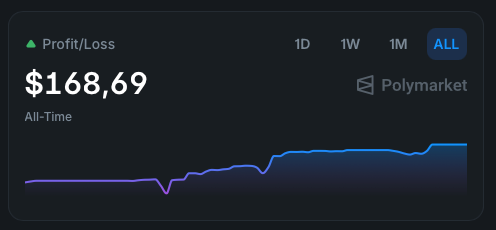
Hello everyone,
welcome to the Historical Results page of
our Bitcoin Volatility Harvest Strategy or Covered Call Strategy applied to Polymarket.
Here I want to be very transparent — something not always common in finance. Over here, you find
the two smart‑contract addresses used by me and my friend Philippe from Canada (Click on the
Wallet Strings over the profit graphs).
Everything shared here is fully verifiable through those two Polymarket wallet addresses. All the transactions made on Polymarket — from opening to closing positions, from profits to losses — can be checked directly through the corresponding links. This is one of the best parts of crypto and the digital world: everything is trackable and open, nothing hides in the shadows. And if there were, it would be immediately visible. That’s the beauty of Polymarket and digital assets in general — full transparency, yet total anonymity at the same time.
Bitcoin owned at the first trade
At the end of November, we bought — and partially already held in a Binance wallet — about USD
5,000 worth of Bitcoin, at roughly 88k per BTC. This allowed us to start placing bets on
Polymarket with strike levels of 90–92k in the following days.
By following indicators and volatility parameters, we managed to do roughly a 4.5× in a month,
reaching around USD 500 in our Polymarket wallet.
Here I have to be honest: the fast growth of our balance, combined with the fact that we were
often selling bets before expiration, made us feel very good at it. We started following less
indicators and parameters trusting the high volatility we saw until that moment. And in just two
days (the first days of January), we lost half of the gains.
All indicators were showing that Bitcoin was increasing in value, but we didn’t stick to our
process. We tried to invest more — and the more Bitcoin went up, the cheaper the downside bets
became. Unfortunately, they became too cheap… to the point they went to zero (sob sob).
So, by the end of the month we started with 115 USDC and ended with roughly 240 USDC.
Two things to remember:
- The fun part: we weren’t really risking anything, because we still held the Bitcoin to cover eventual losses;
- Yes, doubling the initial investment is cool, but we must not forget it was backed by USD 5,000 in Bitcoin — which makes the result less “amazing”, and that’s exactly what differentiates this approach from pure gambling.
Second phase
In January we opened a new Polymarket account, funded it with the 240 USDC, and restarted — this time without being driven by that “good mood” feeling, and following indicators much more carefully.
One important point: when in the second half of January Bitcoin dropped below 90k USD, we were still fully operational because we had already accumulated liquidity from hedging the previous month. The initial 115 USDC had already generated extra dry powder to “play” with.
You already know how the story ends: Bitcoin lost around 25k-30k (30%-35%) from January 20 to
February 6.
This large drop could give us the opportunity to take much bigger profit than what we obtained,
but we are not magicians, we cannot predict the future, and we have jobs, hobbies, and duties.
We don’t want to spend all day in front of a laptop trading. And, last but not least, we are
experimenting, testing strategies, and having fun.
Maybe we were lucky in entering the market during a corrective phase — but isn’t that exactly
the point of the strategy?
Protect ourselves when Bitcoin falls.
Key Success Factors
Achieving these results was not a matter of luck, but of following the structured approach outlined in "The Strategy". Specifically, three elements were crucial:
-
Volatility & Sentiment Indicators: Using the Volatility Insight page was essential to time entries correctly. We entered positions when implied volatility was high relative to realized volatility, maximizing the premium collected.
-
Stop Loss & Take Profit: Discipline is key. We strictly adhered to pre-defined Stop Loss levels to prevent large drawdowns during sharp invalidations, and took profits when the probability of success saturated.
-
Covered Structure: Maintaining the underlying asset (Bitcoin) while selling the upside call ensured that we were never exposed to naked risk on the upside.